The Cloud is Expensive!
Behind this deliberately provocative statement lies a real question: how can you move to or stay in the Cloud without blowing your budget?
Today, Cloud adoption among Swiss companies varies greatly. Among our partners, we meet as many convinced Cloud enthusiasts as we do fervent defenders of on-premise solutions. In every discussion, the question of cost inevitably comes back to the table. Abroad, some players are even going against the grain by initiating a return to on-premise, often motivated by this same reflection on costs.
In our view, to fully benefit from the advantages of the Cloud, it is essential to engage in both a reassessment of company assets and an organizational transformation.
- If you treat the Cloud like on-premise infrastructure, you will miss out on its benefits.
- And if your product teams are not autonomous, you even risk losing significant resources in the process.
In this article, we will focus on the first lever: the reassessment of technical assets.
Reassessing Technical Assets
Migrating to the Cloud cannot be improvised. It is a corporate process that requires preparation. We can cite the 6R strategies here, which allow you to rethink your assets according to different migration trajectories.
| Strategy | Description | Advantages | Disadvantages |
|---|---|---|---|
| Rehosting | Direct movement of applications to the Cloud without major modification ("lift-and-shift") | Potential for automation, rapid implementation | Higher operating costs |
| Replatforming | Slight optimization to take advantage of certain Cloud features, without changing the core architecture ("lift-tinker-and-shift") | Reduced licensing and management costs, better agility | Risk of residual technical debt |
| Repurchasing | Replacing an existing application with a SaaS solution or a different product | Access to modern features, reduced maintenance and infrastructure costs | Possible increase in licensing costs |
| Refactoring/Re-architecting | Complete overhaul of the application to fully exploit Cloud capabilities, often to meet specific business needs (scalability, performance) | Increased performance, business continuity, scalability | More expensive and complex to achieve |
| Retire | Removal of applications that have become obsolete or unnecessary | Cost reduction, simplified management and security, refocusing on useful applications | Potential work to adapt interconnected applications |
| Retain | Temporary retention of applications on-site for strategic reasons | Flexibility for later migration, avoids unnecessary migrations | Increased complexity of hybrid management |
The choice of the right strategy depends on the core of your business.
- Which assets are truly differentiators for your business?
- Which ones are not?
These questions allow you to arbitrate between the software solutions you want to maintain and evolve (your core business) and those that are more relevant to migrate to SaaS solutions (non-differentiating or non-strategic services) or even delegate their management to a partner (BPO). This is the choice between assets to build and assets to buy (Build vs. Buy).
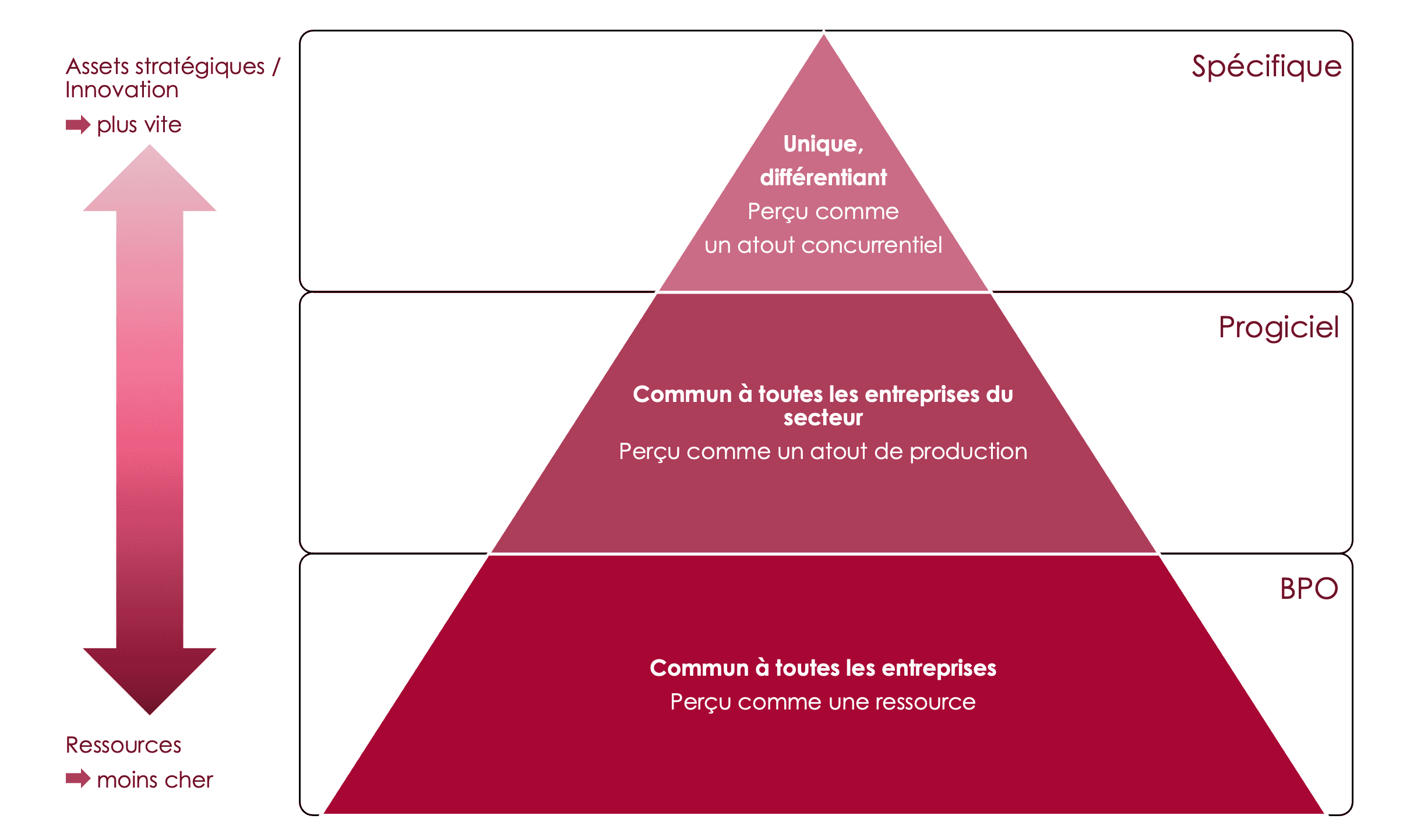
Take the example of a private bank wishing to migrate to the Cloud. One of the historical assets to consider is the accounting system (core banking). This type of system, often deployed on-site, generally has high maintenance costs and update cycles of several months, or even years.
However, a private bank's core business is primarily in service and customer relationships. Furthermore, new SaaS offerings with broad functional coverage and rapid innovation capacity now exist on the market (for example LightFrame).
According to our analysis grid, a "Repurchasing" strategy should be favored over a "Rehosting" strategy. The "Rehosting" strategy also carries the risk of increasing maintenance costs.
Indeed, for organizations that consume significant IT resources like banks, if the Cloud is considered only in its most technical form (IaaS), the rental costs will not be cheaper than the ownership costs of that same infrastructure.
In Conclusion
A successful migration to the Cloud requires choosing an adequate strategy.
Choosing a strategy requires a reassessment of technical assets by distinguishing those that are truly differentiators from those that are commodities (Build vs. Buy).
Beyond the obvious example of "Microsoft Office 365," where no one would dream of developing their own text editor, many historical information systems still contain obsolete services or services that could be replaced by managed services. Reassessing these components ensures that your Cloud investment remains a lever for agility and performance rather than a financial drain.